This week’s readings made me think deeply about what it really means to “show up” in an online learning space. I explored the chapter “Where’s the Teacher?” by Whitney Kilgore and the section on connectivism from 25 Years of Ed Tech. Both readings challenged the idea of what the teacher’s role should be in digital classrooms and showed how crucial teaching presence is in shaping meaningful learning experiences.
Kilgore’s piece explains the Community of Inquiry (CoI) framework, which focuses on three core areas: teaching presence, social presence, and cognitive presence. It’s not just about delivering content—it’s about designing a space where students feel supported, connected, and guided. Meanwhile, connectivism (Siemens & Downes) redefines learning as a process of forming connections, where knowledge is distributed across networks—not just inside one person or a single resource.
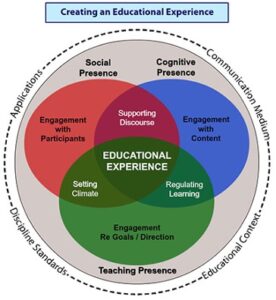
Reading Kilgore’s chapter brought back memories of online courses I’ve taken where the instructor seemed to disappear after week one. Maybe they posted a few announcements or left grades with no feedback, but there wasn’t a real sense of presence. It made those classes feel cold and disconnected—even if the content itself was useful.
What stuck with me most is how Kilgore describes presence as being more than availability—it’s about emotional connection and feedback that feels human. I’ve never really thought about how just a small voice note or check-in from an instructor can make a huge difference in how supported a student feels.
The connectivism section offered a different lens. Instead of thinking about teachers as “the source of knowledge,” it imagines them as facilitators of relationships—between students, tools, platforms, and content. That idea really hit me. I’ve often felt pressure (as a student and in group work) to “deliver the right answer,” but this model reminded me that sometimes it’s more important to ask the right questions and keep the conversation going.
Both pieces reminded me that online learning isn’t just about information—it’s about connection. And connection doesn’t happen by accident. It has to be designed.
I want to think more about how I can create and sustain presence in online settings, even when I’m just a participant. Here are some strategies I’d like to try:
-
Add video or audio feedback when responding to peers or group members
-
Be more active in discussions—ask follow-up questions instead of just replying
-
Collaborate and co-create, instead of only focusing on solo tasks
If we want students to feel like they belong, teachers can’t just be “content managers.” They need to be visible, supportive, and engaged—even if that just means checking in regularly or reacting to a post. Human presence is what makes digital learning actually feel like learning.
Additional Resources:
https://ct.jhsph.edu/blog/posts/Importance-of-COI/
References:
Kilgore, W. (2016). Where’s the Teacher? Defining the Role of Instructor Presence in Social Presence and Cognition in Online Education. https://pressbooks.pub/humanmooc/chapter/wheres-the-teacher-defining-the-role-of-instructor-presence-in-social-presence-and-cognition-in-online-education
Siemens, G., & Downes, S. (2020). Connectivism. In 25 Years of Ed Tech. https://doi.org/10.15215/aupress/9781771993050.01
Johns Hopkins CTL. (2023). The Importance of Building a Community of Inquiry in Your Online Course. https://ctl.jhsph.edu/blog/posts/Importance-of-COI