In my last post, I discussed about my initial curiosity about how AI adapts to my education – its ability to support personalize learning and how it compares to more rigid traditional methods. After that, I spent time researching articles, experimenting with AI tools and reflecting on my own learning experiences.
My curiosity came from hearing tech developers discuss how AI tools like ChatGPT, DuoLingo and Khan Academy’s AI assistant are transforming education. One of the things that really stuck with me was the idea that AI can personalize learning in real time, potentially solving issues like students falling behind or being disengaged due to coursework not matching their level.
To further analyze AI tools, I broke my research down into a few key areas:
- Personalization and Adaptivity
- Retention and Engagement
- Accessibility and Equity
1. Personalization and Adaptivity
Normally a classroom often requires one teacher to manage 20-30 students, making deep individualization difficult. On the other hand, AI tools provide real time, personalized support.
For example, I asked ChatGPT to explain the concept of BEDMAS (brackets, exponents, division, multiplication and addition) at three different levels: high school calculus (grade 11), calculus 1 (first-year university course) and calculus 4 (second/third year university course). It responded with clear, level appropriate language each time and asked follow-up questions to check my understanding, something that most teachers or professors don’t have time for.
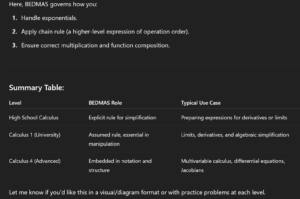
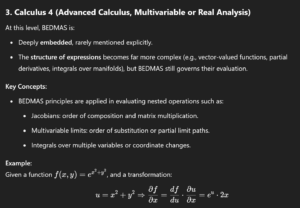
According to Zawacki-Richter et al. (2019), he addresses the idea that AI tools excel at tailoring educational through certain algorithms that respond to student input, pacing and accuracy hence making learning more responsive and student-driven.
2. Engagement and Retention
In traditional settings, students often struggle to stay engaged especially in courses that are fast-paced or conceptually dense. One missed concept can lead to falling behind. AI tools help maintain attention through active engagement and immediate feedback.
For example, while studying a hard topic like partial differential equations in Calc 4, I asked ChatGPT to explain the idea of the Laplacian Operator. Not only did I get a concise definition, it also broke down into steps following up by asking a question. That interaction made want to go deeper and learn the basics of it rather than just skimming the surface. The conversational flow and responsive prompt kept me mentally engaged with the coursework – more so than reading the textbook or watching a video.
Similarly, with Khanmigo; when I practiced implicit differentiation problems, Khanmigo guided me through each step, asking what I thought would come next. When I got a step wrong, it did not just show the right answer – it hinted at what rule I forgot (for example, the chain rule) and then asked me to try again . This active participation helped the steps stick in my memory better than traditional lecture notes or problem sets.
This idea is supported by Holme et. Al (2022) where he stats that this kind of interaction can sustain focus and increase long-term retention by reducing passive learning and cognitive overload.
3. Accessibility and Equity
One of the benefits of AI-based learning tools is how they can bridge gaps in access to quality education. Usually, traditional methods reply on factors like location, instructor availability or even financial privilege. AI tools are helping in that side as well.
As a free and widely accessible tools, ChatGPT makes complex topics accessible to anyone with an internet connection. The ability to ask follow-up anonymously without fear of judgment also lowers the barrier to seeking help – especially for an ESL learner who may hesitate to speak up in class or even go the professor’s office hours.
Khan Academy’s Khanmigo offers not just explanations by interactive coaching across various courses. It is very helpful for students with learning differences. Like a student with ADHD can benefit from the interactive format Khanmigo provides such as breaking a long calculus problem into manageable, guided steps. The tool also reads instructions out loud and has options for visual reinforcement, helping support students who may struggle with text-heavy content.
According to the paper “Let’s Chat about Artificial Intelligence for Students with Disabilities”, AI can play a powerful role in closing education gap, especially for learners with unique accessibility needs.
https://journals.sagepub.com/doi/10.3102/00346543241293424?int.sj-abstract.similar-articles.8
Seeing the way AI platforms respond to different learners has shifted how I think about education equity. I have tutored students with varying needs and I know how they feel when they are behind in a class. These AI tools are not perfect but they are consistent and available 24/7 along with being responsive in ways that traditional settings often are not.
Conclusion
Going into this project, I was curious about whether AI could actually adapt to individual learners better than traditional teaching, I was not sure to expect but the more I explored tools like Khanmigo, the more I realized how powerful and flexible they are.
Through this process, I discovered how much control I had over my own learning, I could ask follow-up questions, request for examples in different format and take as much time as I need without any judgment.
As someone who needs time understand concepts, I appreciate how these tools adjust to me rather than expecting me to adjust to them. I was not just doing my problem sets for the sake of doing it but understanding about how to apply those concepts and that made me feel more confident as a student.
References:
Zhang, L., Carter, R. A., Liu, Y., & Peng, P. (2024). Let’s CHAT About Artificial Intelligence for Students With Disabilities: A Systematic Literature Review and Meta-Analysis. Review of Educational Research.
https://doi.org/10.3102/00346543241293424
Zawacki-Richter, O., Marín, V. I., Bond, M., & Gouverneur, F. (2019). Systematic review of research on artificial intelligence applications in higher education – where are the educators? International Journal of Educational Technology in Higher Education, 16(1).
https://doi.org/10.1186/s41239-019-0171-0