Author: niak

Comment Corner

I have included the links to the blog posts I commented on

  1. Weekly Reflection # 5 – UDL in Higher Education by Anna

Weekly Reflection #5 – UDL in Higher Education

2.

Week 5: Designing for Inclusivity

3.

I included this on Hanne’s post as it awaits moderation.

Post 5 ~ A Personal Reflection

Thank you for such a heartfelt and honest reflection. I really appreciated how you shared both your current strengths and the areas you’re still working on—it’s such a powerful reminder that inclusive teaching is a lifelong journey, not a checkbox.

Your experiences working with the D/deaf and hard of hearing communities clearly inform a thoughtful and intentional practice. I especially liked how you mentioned using closed captions and encouraging sign language use for all students—not just as accommodations, but as ways to create a truly inclusive environment.

I also found it meaningful that you’re actively exploring and embracing Indigenous education, both through your family background and your upcoming courses. The openness you bring to continual learning is inspiring and something I want to carry into my own practice too.

It was refreshing to see you acknowledge the groups and needs you haven’t yet had much experience with, like students with visual impairments. That kind of self-awareness is so important and shows that you’re not just talking about inclusion—you’re actively living it.

Your mention of building a Personal Learning Plan with mentors and resources really resonated with me. That’s such a valuable way to stay intentional and accountable in this work. Thanks again for sharing your reflection—it gave me a lot to think about and learn from!

4.

Weekly Reflection #5

5.

Added this on Dylan’s post

This was a great read! I really liked how you combined theory, real-world platforms, and personal reflection—it made your post feel super grounded. The shift in how you view facilitation really stood out to me. It’s so true that “doing less” can sometimes be the most powerful way to support learning. Also, loved the comparison between Coursera and Outschool—such a clear example of what good facilitation looks like in action.

Thanks for sharing!

6.

Blog Post 5:Weekly Reflection

Blog #5: Inclusive and Universal Design

This week, I read two resources that really got me thinking: one from the Inclusive Design Research Centre and the other from UDL On Campus. Both talk about making learning environments more inclusive, but they approach it in slightly different ways.

Inclusive Design focuses on embracing human diversity and allowing for flexibility and personal customization. Instead of aiming for a “universal fit,” it focuses on adapting systems to suit individual needs—especially for people who are usually left out. Universal Design for Learning (UDL), on the other hand, aims to build in multiple ways for students to learn and express themselves right from the start, so no one gets left behind.

Inclusive Design is built on three core ideas:

  • Every learner is different and unique.

  • The process should include those who are most often excluded.

  • Design should aim for long-term, wide-reaching impact.

If you’re curious, I have attached two videos that give a quick explanation of inclusive design and UDL.

To be honest, I was a little familiar with UDL because I learnt about it before. In my opinion I think it’s a great model, and I like how it encourages educators to offer choices in how students engage with content. I just wish I used it more frequently instead of just one time. That said, I hadn’t heard much about Inclusive Design before this week—and now I’m wondering why it’s not talked about more often.

What stood out to me was how Inclusive Design isn’t about adjusting things after the fact—it’s about including people from the beginning. That feels more powerful to me. Instead of saying “Let’s make this accessible,” it says “Let’s build this with the people we’re trying to include.” That shift in mindset really stuck with me.

Still, I can’t help but think about how hard this might be to implement. I picture a teacher with a classroom full of students who all have different needs. It sounds great in theory to design something that works perfectly for each person, but how realistic is that when there are time pressures, limited resources, and other challenges? Wouldn’t that create a lot of extra stress on the teacher?

It makes me wonder: is it fair to expect educators to do all this without the proper support systems in place? I totally believe in the goal, but if it leads to teacher burnout, isn’t that another form of failure? There has to be a balance somewhere.

Inclusive Design and UDL both have so much potential to make learning more accessible and empowering for everyone. But reading about them also raised some tough questions for me—especially around practicality, ethics, and educator well-being.

References:

UDL on Campus: About UDL. (n.d.). http://udloncampus.cast.org/page/udl_about

Philosophy – Inclusive Design Research Centre. (n.d.). Inclusive Design Research Centre. https://idrc.ocadu.ca/about/philosophy/


Blog #1: Learning from the past

This week, Martin’s Weller’s Twenty Years of EdTech and Liz Marr’s chapter on the Open University’s evolving pedagogy offered a powerful opinion on how educational technology has evolved and what lessons we should carry.

Weller highlights the idea of one key or concept per year: wikis(1998), e-learning(1999), MOCs(2012) and learning analytics(2014). While some innovations came with promise, few truly transformed educated unless paired with inclusive thoughtful pedagogy.

Whereas, Marr discusses how the Open University centered equity from its beginnings as a “University of the Air” to its current model of digitally supported , personalized learning. Some of the tools she discussed were learning analytics for pre-entry and on-course interventions and Student Hub Live for community-building in online spaces.

Weller’s timeline reveals how EdTech repeats itself. Tools like e-portfolios did not see much success as they were not grounded in actual learner needs. However, Marr’s analysis states that putting content online is not enough as learners need structure, support and interaction. These insights remind me of the ideology that “access is not the same inclusion”. A student can log into a learning management system but still feel isolated or overwhelmed. Marr’s example of James – a working adult struggling with family responsibilities shows how learning analytics is used to compassionately identify and support learners in real time.  In comparison to this, Weller critiques tools like MOOCs for their hype-driven rollout, contrasting with the fact that more learner-centered tools like blogs that tend to foster identity and voice.

I think as a learner,  I hope I can promote EdTech that:

  • Builds communities like Student Hub Live
  • Offers feedback and flexibility through thoughtful design
  • Prioritizes learner well-being and digital equity.

Resources:

I decided to include this session by Student Hub Live which embraces neurodiversity and shows inclusive live support strategies, showing how tech can foster belonging and help create a community in distance learning like Marr described.

References:

Weller, M. (2018). Twenty Years of Edtech. Educause. https://er.educause.edu/articles/2018/7/twenty-years-of-edtech

Zorn, A., Haywood, J., & Jean-Michel Glachant. (2018). Higher education in the digital age : moving academia online. Edward Elgar.

Free Inquiry Project – Last Post

In my last post, I discussed about my initial curiosity about how AI adapts to my education – its ability to support personalize learning and how it compares to more rigid traditional methods. After that, I spent time researching articles, experimenting with AI tools and reflecting on my own learning experiences.

My curiosity came from hearing tech developers discuss how AI tools like ChatGPT, DuoLingo and Khan Academy’s AI assistant are transforming education. One of the things that really stuck with me was the idea that AI can personalize learning in real time, potentially solving issues like students falling behind or being disengaged due to coursework not matching their level.

To further analyze AI tools, I broke my research down into a few key areas:

  • Personalization and Adaptivity
  • Retention and Engagement
  • Accessibility and Equity

1. Personalization and Adaptivity

Normally a classroom often requires one teacher to manage 20-30 students, making deep individualization difficult. On the other hand, AI tools provide real time, personalized support.

For example, I asked ChatGPT to explain the concept of BEDMAS (brackets, exponents, division, multiplication and addition) at three different levels: high school calculus (grade 11), calculus 1 (first-year university course) and calculus 4 (second/third year university course). It responded with clear, level appropriate language each time and asked follow-up questions to check my understanding, something that most teachers or professors don’t have time for.
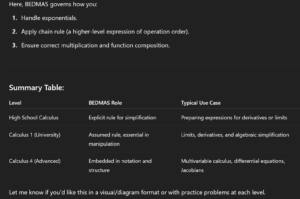
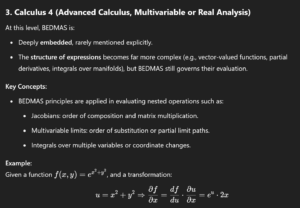
According to Zawacki-Richter et al. (2019), he addresses the idea that AI tools excel at tailoring educational through certain algorithms that respond to student input, pacing and accuracy hence making learning more responsive and student-driven.

2. Engagement and Retention

In traditional settings, students often struggle to stay engaged especially in courses that are fast-paced or conceptually dense. One missed concept can lead to falling behind. AI tools help maintain attention through active engagement and immediate feedback.

For example, while studying a hard topic like partial differential equations in Calc 4, I asked ChatGPT to explain the idea of the Laplacian Operator. Not only did I get a concise definition, it also broke down into steps following up by asking a question. That interaction made want to go deeper and learn the basics of it rather than just skimming the surface. The conversational flow and responsive prompt kept me mentally engaged with the coursework – more so than reading the textbook or watching a video.

Similarly, with Khanmigo; when I practiced implicit differentiation problems, Khanmigo guided me through each step, asking what I thought would come next. When I got a step wrong, it did not just show the right answer – it hinted at what rule I forgot (for example, the chain rule) and then asked me to try again . This active participation helped the steps stick in my memory better than traditional lecture notes or problem sets.

This idea is supported by Holme et. Al (2022) where he stats that this kind of interaction can sustain focus and increase long-term retention by reducing passive learning and cognitive overload.

3. Accessibility and Equity

One of the benefits of AI-based learning tools is how they can bridge gaps in access to quality education. Usually, traditional methods reply on factors like location, instructor availability or even financial privilege. AI tools are helping in that side as well.

As a free and widely accessible tools, ChatGPT makes complex topics accessible to anyone with an internet connection. The ability to ask follow-up anonymously without fear of judgment also lowers the barrier to seeking help – especially for an ESL learner who may hesitate to speak up in class or even go the professor’s office hours.

Khan Academy’s Khanmigo offers not just explanations by interactive coaching across various courses. It is very helpful for students with learning differences. Like a student with ADHD can benefit from the interactive format Khanmigo provides such as breaking a long calculus problem into manageable, guided steps. The tool also reads instructions out loud and has options for visual reinforcement, helping support students who may struggle with text-heavy content.

According to the paper “Let’s Chat about Artificial Intelligence for Students with Disabilities”, AI can play a powerful role in closing education gap, especially for learners with unique accessibility needs.

https://journals.sagepub.com/doi/10.3102/00346543241293424?int.sj-abstract.similar-articles.8

Seeing the way AI platforms respond to different learners has shifted how I think about education equity. I have tutored students with varying needs and I know how they feel when they are behind in a class. These AI tools are not perfect but they are consistent and available 24/7 along with being responsive in ways that traditional settings often are not.

Conclusion

Going into this project, I was curious about whether AI could actually adapt to individual learners better than traditional teaching, I was not sure to expect but the more I explored tools like Khanmigo, the more I realized how powerful and flexible they are.

Through this process, I discovered how much control I had over my own learning, I could ask follow-up questions, request for examples in different format and take as much time as I need without any judgment.

As someone who needs time understand concepts, I appreciate how these tools adjust to me rather than expecting me to adjust to them. I was not just doing my problem sets for the sake of doing it but understanding about how to apply those concepts and that made me feel more confident as a student.

References:

Zhang, L., Carter, R. A., Liu, Y., & Peng, P. (2024). Let’s CHAT About Artificial Intelligence for Students With Disabilities: A Systematic Literature Review and Meta-Analysis. Review of Educational Research.

https://doi.org/10.3102/00346543241293424

Zawacki-Richter, O., Marín, V. I., Bond, M., & Gouverneur, F. (2019). Systematic review of research on artificial intelligence applications in higher education – where are the educators? International Journal of Educational Technology in Higher Education, 16(1).

https://doi.org/10.1186/s41239-019-0171-0


Free Inquiry Project – Week 2

I spent some time testing out a few AI learning tools and I focused on:

  • ChatGpt: I asked it to explain some of the math topics I have learned before to just see how it would respond and if it adapted based on questions.
  • Khan Academy’s AI assistant (KhanMigo): I used it for the same purpose and tracked how it gave me feedback based on my answers.

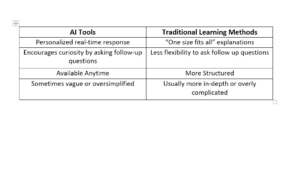
It was interesting to see that both tools tried to adjust the experience to my level ; especially KhanMigo as it asked questions rather just giving answers right away. I liked that it gave me hints and guided me to think instead of solving everything for me.

The tools were really helpful and fast however there were some limitations. For example, ChatGPT sometimes gave vague answers. Whereas, traditional learning materials like classroom lecture or notes are more structured and are in more depth which some learners really benefit from.

I’m starting to realize that AI is not a full replacement for traditional learning but it does fill gaps in learning – especially for quick help, review or when you want to explore a topic on your own pace. I think one of the interesting thing about AI tools is that those don’t remember your learning history, limiting how deeply they can personalize your learning journey compared to a human teacher who knows your struggles.

I do think there is potential of AI tools becoming even better at this over time and for self-motivated learners, it is definitely very help to have these tools to get instant answers and guidance.

Free Inquiry Project: Week 1

I decided to focus on AI-based learning tools for my Free Inquiry Project, specifically looking into whether AI can better adapt to individual learning needs as compared to more traditional learning methods like textbooks, lectures or fixed lesson plans.

AI in Education: Educational AI Tools and Their Impact

I think my interest sparked from the idea of how quickly AI has become part of education, from platforms like Khan Academy’s AI tutor to apps that create custom flashcards. I want to learn more about what these tools are truly helping learners in a personalized way or if they are just a replacement for things we have already been doing in school.

I want to start by trying out a few different AI learning tools and documenting how they work. I also want to compare that to traditional learning methods I have experienced in school like lectures, readings or paper-based practice. Along the way, I want to  discuss the benefits and challenges of AI in education and reflect on whether it really feels like these tools are “adapting” to my needs as a learner.

I hope this project helps us understand how this kind of technology might shape the future of learning and whether it’s a supplement or a serious alternative to traditional methods.

Blog #4: Online Learning Environments

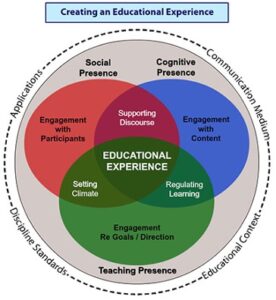
This week’s readings made me think deeply about what it really means to “show up” in an online learning space. I explored the chapter “Where’s the Teacher?” by Whitney Kilgore and the section on connectivism from 25 Years of Ed Tech. Both readings challenged the idea of what the teacher’s role should be in digital classrooms and showed how crucial teaching presence is in shaping meaningful learning experiences.

Kilgore’s piece explains the Community of Inquiry (CoI) framework, which focuses on three core areas: teaching presence, social presence, and cognitive presence. It’s not just about delivering content—it’s about designing a space where students feel supported, connected, and guided. Meanwhile, connectivism (Siemens & Downes) redefines learning as a process of forming connections, where knowledge is distributed across networks—not just inside one person or a single resource.


Reading Kilgore’s chapter brought back memories of online courses I’ve taken where the instructor seemed to disappear after week one. Maybe they posted a few announcements or left grades with no feedback, but there wasn’t a real sense of presence. It made those classes feel cold and disconnected—even if the content itself was useful.

What stuck with me most is how Kilgore describes presence as being more than availability—it’s about emotional connection and feedback that feels human. I’ve never really thought about how just a small voice note or check-in from an instructor can make a huge difference in how supported a student feels.

The connectivism section offered a different lens. Instead of thinking about teachers as “the source of knowledge,” it imagines them as facilitators of relationships—between students, tools, platforms, and content. That idea really hit me. I’ve often felt pressure (as a student and in group work) to “deliver the right answer,” but this model reminded me that sometimes it’s more important to ask the right questions and keep the conversation going.

Both pieces reminded me that online learning isn’t just about information—it’s about connection. And connection doesn’t happen by accident. It has to be designed.

I want to think more about how I can create and sustain presence in online settings, even when I’m just a participant. Here are some strategies I’d like to try:

  • Add video or audio feedback when responding to peers or group members

  • Be more active in discussions—ask follow-up questions instead of just replying

  • Collaborate and co-create, instead of only focusing on solo tasks

If we want students to feel like they belong, teachers can’t just be “content managers.” They need to be visible, supportive, and engaged—even if that just means checking in regularly or reacting to a post. Human presence is what makes digital learning actually feel like learning.


Additional Resources:

https://ct.jhsph.edu/blog/posts/Importance-of-COI/

References:

Kilgore, W. (2016). Where’s the Teacher? Defining the Role of Instructor Presence in Social Presence and Cognition in Online Education. https://pressbooks.pub/humanmooc/chapter/wheres-the-teacher-defining-the-role-of-instructor-presence-in-social-presence-and-cognition-in-online-education
Siemens, G., & Downes, S. (2020). Connectivism. In 25 Years of Ed Tech. https://doi.org/10.15215/aupress/9781771993050.01
Johns Hopkins CTL. (2023). The Importance of Building a Community of Inquiry in Your Online Course. https://ctl.jhsph.edu/blog/posts/Importance-of-COI


Blog #3: Digital Futures of Education

While we continue to navigate a decade shaped by rapid technological innovation, this week’s readings prompted a deep reflection on the developing relationship between education and artificial intelligence. Bozkurt. et al discusses about the speculative features shaped by tools like ChatGPT, revealing both hopeful and cautionary tales of AI’s integration in classrooms. Whereas, Selwyn et al. addresses a grounded critique of educational technologies, focusing on socio-political forces shaping educational technology in 2020s.

Bozkurt et al. presents a diverse collection of speculative stories from researchers worldwide, imagining how AI tools like ChatGpt can transform or disrupt education. The paper explores both optimistic and dystopian scenarios: personalized learning, holographic tutors, AI- enhanced inclusivity as well as concerns over surveillance and loss of creativity. However, Selwyn et.al identifies six major challenges for educational technology for this decade, such as deepening digital inequality, the unchecked power of AI-fueled platforms, blurred boundaries between human and machine learning.

AI has the potential to personalize and expand access to education especially for students who may struggle with traditional methods. Tools like ChatGPT do provide instant feedback and can adapt to individual learning needs. However, as Bozkurt And Selwyn emphasize, the future of educational technology is not going to be shaped by technology itself but instead it depends on the intentions, ethics and frameworks we use to guide. That realization stood out to me and these readings have helped me move beyond the classic thinking and instead seeing the importance of intentional critical engagement.

The UNESCO video “Digital Learning and AI in Education” captures the same balance of excitement that Bozkurt and Selwyn present in their work. Like the readings, this video emphasizes that while AI offers tremendous potential like personalized learning and increased accessibility its true impact depends on the ethical, social and political choices we make. This directly connects to my realization that the future of educational technology would be determined by the tools themselves but by how intentionally we engage with them.

References:


Selwyn, N., Hillman, T., Eynon, R., Ferreira, G., Knox, J., Macgilchrist, F., & Sancho-Gil, J. M. (2019). What’s next for Ed-Tech? Critical hopes and concerns for the 2020s. Learning Media and Technology, 45(1), 1–6. https://doi.org/10.1080/17439884.2020.1694945

Bozkurt, A., Xiao, J., Lambert, S., Pazurek, A., Crompton, H., Koseoglu, S., Farrow, R., Bond, M., Nerantzi, C., Honeychurch, S., Bali, M., Dron, J., Mir, K., Stewart, B., Costello, E., Mason, J., Stracke, C. M., Romero-Hall, E., Koutropoulos, A., . . . Jandrić, P. (2023, March 11). Speculative Futures on ChatGPT and Generative Artificial Intelligence (AI): A Collective Reflection from the Educational Landscape. https://www.asianjde.com/ojs/index.php/AsianJDE/article/view/709

Selwyn, N. (n.d.). Neil Selwyn. https://der.monash.edu/facing-up-to-the-dilemma-of-sustainable-digital-futures/

Blog #2: Rethinking Openness

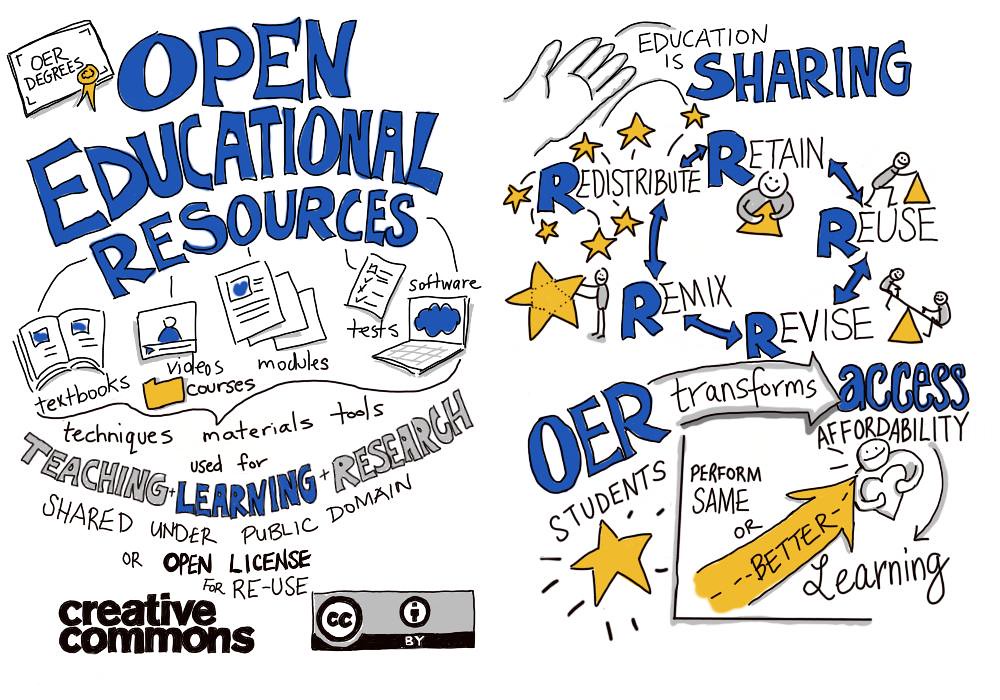
After reading Open Practices: Briefing by Beetham et al. (2012), I found myself both inspired and little overwhelmed by the potential and complexity of open educational practices (OEP). The briefing about UK’s OER program’s findings explores how OER are not just about free content – they’re about reshaping how we teach, learn and share knowledge.

Using Open Educational Resources (OER's) and Textbooks | Lakehead University

At its core, OEP is about equity, collaboration and innovation. It is not just about putting a PDF online but instead about encouraging learners to co-create knowledge, academics to share their teaching practices and institutions to embrace transparency in both content and methodology.  The paper argues that this openness goes beyond the resources into pedagogy, research and even student assessment models. It creates a shift in the mindset.

One of the most compelling parts of the paper is how it frames OEP as a cultural shift, for example, teachers are not just expected to post content online; they are encouraged to engage in public scholarship, open peer review and use social media as a mean of academic exchange. The paper also addresses student role in openness. Student access to free content is very helpful but when they contribute back, for example, collaborating on wikis or building open course content, this blurs the lines between a learner and an educator in powerful ways.

By the time I finished reading the paper, I was left wondering, “how can I start small?” Maybe by designing a project where students blog about their learning or by choosing to publish my lesson plans. I think one thing I learned from this is that openness is not a destination but instead a practice. It requires rethinking power dynamics, taking ownership of your own learning and the very structure of education.

I chose to include this TedTalk as it reinforces the idea that open educational practices (OEP) are not just about free access to content – they are about fundamentally rethinking the roles of educators and learners. Wiley’s emphasis on sharing as the core of education aligns with the paper’s call for openness in pedagogy, assessment and collaboration. He captures the idea of openness as a cultural shift perfectly by arguing that educators must not only share resources but also invite students  into co-creation of knowledge. His talk made me feel more confident in starting small like having students blog or by making my own lesson plans available.

References

Beetham, H., Falconer, I., McGill, L., Littlejohn, A., & JISC. (2012). Open practices: briefing paper. https://oersynth.pbworks.com/w/file/fetch/58444186/Open%20Practices%20briefing%20paper.pdf

© 2026 nkblogs

Theme by Anders NorenUp ↑